My Travels

June 2018

Japan – Tokyo only – Part 1

You don’t understand Japan and the Japanese until you actually visit Japan and observe the behavior of your Japanese   friends  (both in Japan and abroad) over a period of time. Now I have done both. This does not make me an expert on Japan. Yet the conclusions I will draw by myself  are not in any book or film or video.  These are unwritten and unpublished truths  about the Japanese society.  So here they come (without much evidence hahaha) – I invoke my freedom of expression rights, so  don’t hate me!!

The Japanese feel that they are superior to other people

The Japanese feel that the others are uncivilized .  Asians and Africans are  more uncivilized than people from Western Europe and USA.

The Japanese have many  rules and customs and etiquettes – some formal, some informal, some strictly enforced, some expected of good citizens. Almost all of us foreigners can not possibly follow these customs . We are excused by the Japanese for failing their standards but at the same time, under all the politeness,  they  feel smug at our lack of sophistication.

The Japanese do not care much about diversity.  They like their society as it is, a sprinkling of working foreigners and resident  hafus (mixed race)   that they currently have is sufficient.

They do not care about economic growth that much – in fact stagnation is OK with them. They  already have a high standard  of living and they want to stagnate around that forever.

The Western media cares more about Japanese stagnation than the Japanese citizens.

Nor are they worried about declining birthrates, or decline in the number of married people.

Mostly, they do not wish to travel to uncivilized countries in Asia (includes India,  Malaysia etc.)or Africa or Latin America.   USA and Western Europe are OK .

The Japanese love Japan. Even with foreign degrees, good jobs in USA or Europe, they will ultimately  return  to the land of the rising Sun unlike us Indians or Chinese or others.  Dissenting citizens, rebels ,  misfits and escapists of course exist in every society  and Japan is no exception.

The Japanese  like to claim that they work very hard, in fact they quote long working hours and high burnout rates etc.,  to prove this. While some people of course work very hard and /or burn out (in every country), a little more probing will reveal the following:

A lot of work is “pretend” make-up work. In order to submit a report to a high level  employee of the same company in a different office, email or fax is supposedly insulting. Somebody has to go clear across town to deliver the report, chat with the employee and maybe have coffee. Five hours of “hard work” that could be accomplished in one minute!!

In a university, a lot of professors bring sleeping bags and sleep in their offices because they are doing so much research! You can draw your own conclusions.

Every evening,  in the central business and entertainment  district ( Shinjuku, where I stayed for four nights) , there are literally hundreds of bars and restaurants and they are all packed from early evening.  Tourists?  Teenagers?   Singles hunting for partners? Yes, but these still do not explain the huge crowds every single night.  We are looking at an area about  twenty  times the size of Park Street in Calcutta, or Times Square in New York City, with bars and restaurants at almost every building! And there are similar areas in Central Tokyo and many other places. The crowd consists of people working! Yes,  drinking, eating , smoking, chatting and maybe talking business a little bit.  All on company time.  I won’t mind working  hard like that! After all that hard work, they are too tired (drunk) to go home, so they crash at a cheap hotel, and go back to the office in disarray the next morning!!

Because the way they are brought up, the Japanese are socially awkward . In the famous cat café, I saw Japanese men quietly sitting next to cats, not interacting with them,  after paying a hefty admission fee to go in and play with cats!!

In the subway or train , restaurant, or even in a park, many people are seen working on their phones or laptops instead of talking. This accentuates the hard work syndrome!

All tourist spots, temples, shrines, parks, iconic buildings, are all packed with Japanese people every day in addition to  foreign tourists. Tourists  from  outside Tokyo ? Well , they are supposed to be working hard too!! My guess is that the Japanese get a lot of days off from their  arduous work schedule, they just  don’t want to admit that  they do!

Obviously, not everyone in Japan holds these opinions, there are many exceptions !

Now I write about the good stuff! Japan’s society is so outstanding in many ways that I would happily vacation there every year even if  all the above stereotypes are true for every single Japanese person (and they are not, obviously!)

The transportation hubs in Tokyo  are massive! They were overwhelming to me when I landed in Tokyo, but once you figure out everything,  it is really impressive and well-organized.  Shinjuku station has five floors , one for subway trains, one for long-distance trains, one for long-distance buses ,  one for local buses, and one level for taxis and private cars. You can plan your nation-wide travel itinerary from that one place!   And the entire building  is full of restaurants and takeaway places and it is next to huge shopping areas. I had a hotel near the station. I took a train from Narita international airport to here on arrival in Japan,  then used the same Shinjuku station for subway rides inside Tokyo and left by long-distance bus from the same Shinjuku station for Mt. Fuji.  Subway trains are numerous and color-coded and well-organized, yet I managed to get lost on the first day and had to rebuy my tickets, so  thereafter  I bought an all-day ticket every day in Tokyo, and Kyoto and Osaka.

The cleanliness of  the streets is striking! They  do not allow smoking on the streets because the ash from your cigarette will make the streets dirty ( not the butts which you can dispose of separately) . Surprisingly, you can smoke in many bars and restaurants because the Japanese respect your private space, although this is changing fast!! But heck, I have no idea how they keep the streets and the sidewalk spotlessly clean even in high traffic areas.

The discipline and the politeness of   the people  working everywhere is amazing! You do not tip the wait staff in restaurants   or the taxi-drivers in Japan because they are insulted if you do so (no kidding)!

The politeness of people on the street and in social situations  is totally off the charts! I think in Tokyo, you can take off all your clothes and step into a busy street  while playing with your private parts and you will be summarily ignored until the Police politely asks you if you need help  (alright, I made this one up!)

You will see bicyclists riding for about 20 meters on the sidewalk, stopping because they would not use the bell to distract the pedestrians in front and dismounting and walking behind them until they can ride again maybe this time for 15 meters!!

Everywhere  in a humongous city like Tokyo, you see young boys and girls (8 to 13) taking the subway to school alone , hanging out in groups or playing in parks unsupervised.  Older kids, 14 to 18, work in convenience stores  or takeaway places, sometimes unsupervised by adults.  Nobody kidnaps them, nobody assaults them , nobody robs them (try this in USA!!)

And, no, in case you have turned on your filthy imagination, teenage girls are normally dressed, or sometimes weirdly dressed with multi-colored hair and funky accessories, but not wearing micro-mini skirts and trying to seduce older men for money. If this does go on in Japan, it is an online,  secret  thing using only Japanese language, and I did not see any evidence of  that at all in public places – I was not looking for it anyways!!

The punctuality of Japanese transportation that you may have heard of is all true. A train leaving at 2:13 pm will not leave at 2:14 pm. Even  my  long –distance bus to Fujiyama from Tokyo went through highways and little towns and arrived on the dot after  four hours.

Japanese food turned out to be surprisingly tasty! They use a small amount of spices, but skillfully enough so that the food becomes flavorful.  This applies to all the beef and fish soups and entrees  I  have eaten in Japan.  And all the pickled and cooked veggies.  Of course I liked the sushi and the tempura too.

What is even  more remarkable is that the quality of food is the same everywhere. You can buy a chicken sandwich, or a lunch combo with soup and a piece of fish and pickled veggies from a roadside convenience store or from an expensive restaurant, they will taste the same. The restaurants only offer much more variety and ambience at much higher prices.  As soon as I discovered this I started having excellent meals in my hotel room that I bought from roadside convenience stores.  A meal of  four small sandwiches (egg salad, tuna, roast beef, and Japan’s unique strawberry and cream sandwich) and a small salad and a small pastry will be about 8 dollars and everything will be super fresh and taste great!  A meal like that in a proper restaurant will cost at least twice as much.

The Japanese are very innovative about service in restaurants – some of these are now being implemented in other countries.  

You may have seen or  visited the rotating wheel restaurants where freshly prepared food items  are loaded on to the conveyor belt. You grab whatever you like.  This lets you taste many small items.

Another  way is online menus at the  tables, your order reaches the kitchen online and delivered to you by the waiter. I have seen this in USA   during recent years. Still another way is to look at the menu items at the entrance, order and pay at the machine at the gate  and get a receipt. When you are inside,  your receipt gets you the food you ordered already.

Then there are specialized places in entertainment districts. Apart from the ubiquitous Karaoke bar, there are Robot cafes, Anime cafes,  Maid cafes, and so on. And  finally cat and dog cafes where you can hang out with your favorite  animals and have a latte at the same time. I tried the cat café, and loved it, pics are in part 2.

You can not finish a discussion of Japanese food without discussing their vending machines. Yes, they have scores of beverages  and snacks instead of only a handful  in USA or Europe. You can also get prepackaged food and freshly cooked food in some machines that are supposedly very good.  And machines are everywhere including at  the street corners.

I did not try the food, but I tried all kinds of weird drinks and liked some of them
( my favorite : Pokari  Sweat Water – yes sweat water!!)

No drugs, no crime, decent food , excellent transportation and entertainment options, and decent salary and job security  even for low level jobs – the Japanese have quite a high standard of living indeed . Apartments, like hotel rooms,  are tiny  but clean and efficient  – and  outside Tokyo, they are not that tiny!  The only problems I heard of  is regarding welfare payments for the unemployed ( a single mother with two young children will not earn enough to pay for childcare and  living expenses – this problem, though serious,  exists in  almost  every country).  Healthcare coverage is a lot less comprehensive for working adults in recent years.  On the other hand, for many seniors, health care coverage has been so excellent that  many  people of 100+ years  continue to  roam the streets, which results in some obvious social problems of depression, abandonment and loneliness.

Talking about senior citizens, I thought I was in decent physical shape for a man in my mid-sixties. The Japanese senior brigade put me into deep shame.  I have never seen so many old folks with flat stomachs and ramrod straight posture, hiking, biking,  exercising  and playing sports (and apparently, having sex too)  in their sixties, seventies and eighties.  Damn! Damn!

So what did I see in Tokyo?

 Part 2 coming up with pics

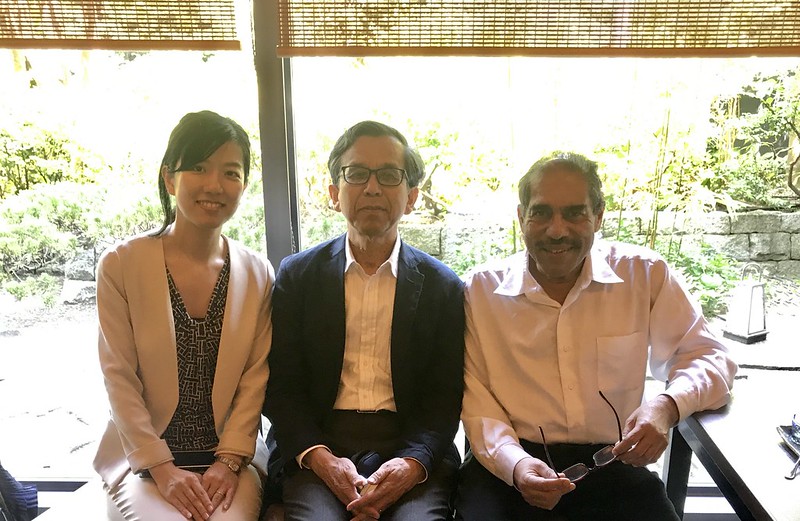
Here are friends from Rochester after about 38 years!
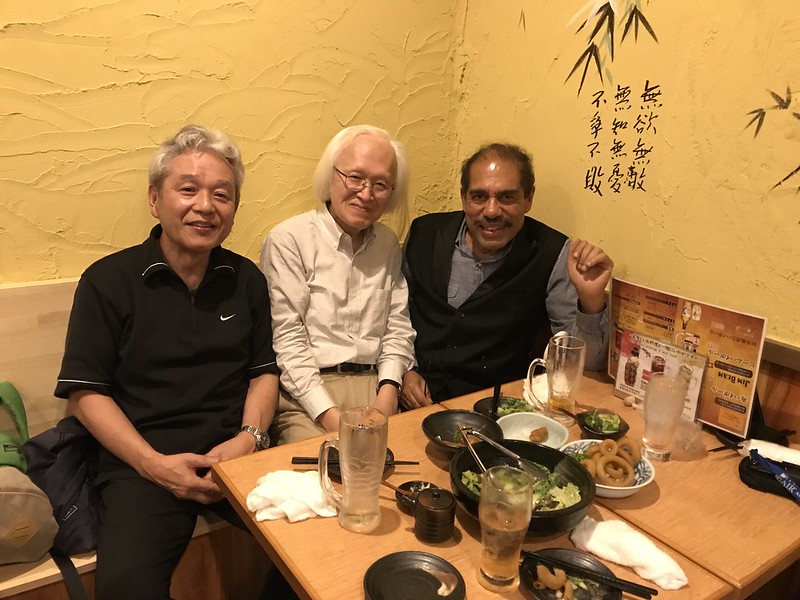
Dr. Takahashi and Dr. Kodaira
Dr. Fukiharu with daughter

My trip to Alaska, Part 2

Alaska Travel Part 2

Ports of Call on the Celebrity Solstice Cruise

As I am writing this in 2020, I recall fondly the small cities in Southwestern Alaska .  They used  to be quiet fishing  towns , with the exception of Juneau which used to be a sleepy state capital . Alaska’s total  population is less than  200K, so the state capital is not a very big deal – a medium sized city in contiguous USA has more than 200K residents. Juneau has only 30K people.

The Alaska Ferry  is the main  mode of  commuting  to these coastal cities, most of them do not have any access by road, although  they also have small airports as well.

Once the Alaska Cruises became popular, these cities now host   many humongous ships per day . Each ship disgorges from 1000 to 3000 passengers, who spend a few hours in these towns, sightseeing, shopping, eating  and just aimlessly walking around beside the harbor.

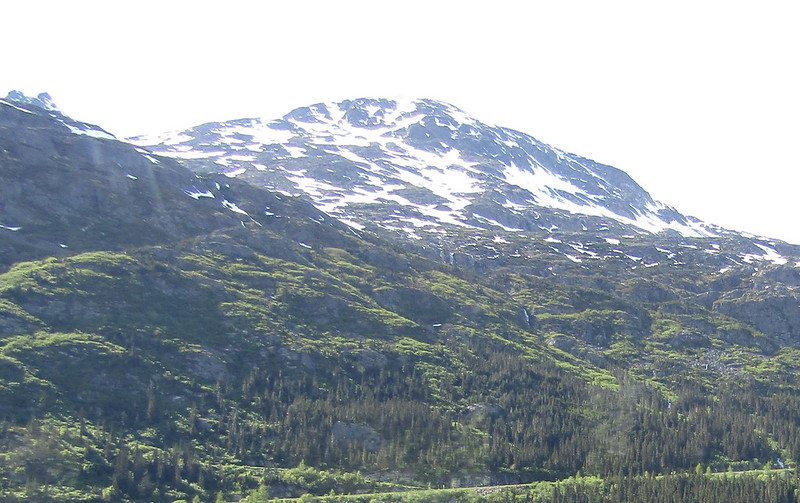
These little towns on the western coast of Alaska are beautiful.   They are right on the ocean, usually with a big harbor good for large ships. Behind the little town there are mountain ranges, and/ or dense forests and no human habitation for hundreds of miles.  So there are no roads to access the mainland on other side of the mountains.

Interestingly, some of these little towns were swamped by people in the mid 1800’s, people chasing gold landed here then went by foot or mule to the hinterlands in the Yukon territories.  Lawless and uncouth townships sprouted, most people spent countless days searching for gold , panning the rivers and ponds , a few lucky ones found large nuggets or plots of land with veins of gold.  It was a short lived time of prosperity for these little towns which worked as landing stations for the famous Yukon Gold Rush.  After that ended, the towns lived  in relative obscurity with fishing and canning for about a century. The folks that lived there are real hardy, the weather is brutal for about six months, and nasty for about four additional months. During two months of summer,  it rains most of the time and the temperature is from 40 to 60 degrees Fahrenheit.

Juneau is one of these towns  – an exception because the state capital shifted there in 1906. The others with their romantic names,  Ketchikan, Skagway, Sitka,  Hoona, , Metkatla, Hydabug  and many others dot the coastline , the lucky (!) ones get  up to a million or more tourists  from Cruise ships per year. One of my American colleague’s sons that I have met as a teen , dropped out of mainstream USA, and lives in Hoona, Alaska nowadays !

As the cruise ships  got bigger (actually massive), summers  in these towns were transformed completely.

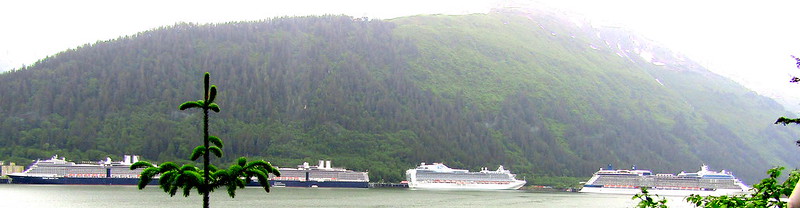
Ship Parking – Juneau!
Ship traffic jam!
Big ship entering little Juneau harbor

Everyday, starting around 8 am, the ships dock and discharge hordes of mainly elderly people.  Some stay in town,  snacking, lunching and shopping.  In a daring effort at vertical integration, the cruise ship companies have opened their own gift shops and restaurants in these towns. Yes, you can buy  Peruvian Alpaca  sweaters in Ketchikan, Alaska  at  exorbitant prices, or get  Swarovski crystals for your sweetheart at double the usual price at Juneau!! For the townspeople and some itinerant workers that come during the summer, it is their only chance to make a few bucks by selling pizza, sandwiches, coffee and souvenirs – they totally resent the encroachment from the shops owned by the Disney  or Celebrity cruises, although they welcome the tourists bought in by them.

For the more physically active folks there are lots of activities offered as day tours – they run from 50 to 500 dollars depending on the activities and the duration, This is my evaluation of these trips (according to my own preference)

1.     Native American cultural tour – mainly Tippis and totem poles and lectures from a guide. Go if you are really interested.

2.     City sightseeing and food tours – the historical sights in these cities are at best unremarkable and the food is way better in modern cruise ships and free too if you are on the cruise!!

3.      Hiking or biking tours – you will see wonderful scenery – land and mountains and oceans  – take the mild to moderate tours unless you are below forty and in great physical shape . If you are in great Physical shape, then you are rewarded with a spectacular trekking experience. But you are unlikely  to be on a cruise ship with that demographic – unless , of course you are on your honeymoon in which case you may have other pleasant activities in mind!!

Remember it rains frequently and hard and it is cold and windy during   summer.  There are occasional gorgeous days with sunshine though!

4.     Wildlife tours – mainly moose and elk. If you live in North America, you may have seen them already, occasionally you may see black bears, but unlikely during the day when these tours occur. Tons of horse flies, gnats,  mosquitoes and other insects inside the forests – and they bite hard!

5.     Glacier trips – yes!

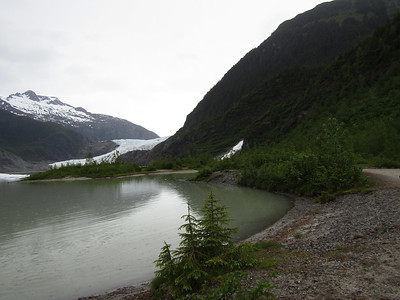
Mendenhall Glacier near Juneau

6.     Whale-watching boat rides – yes!

They cost some real money!

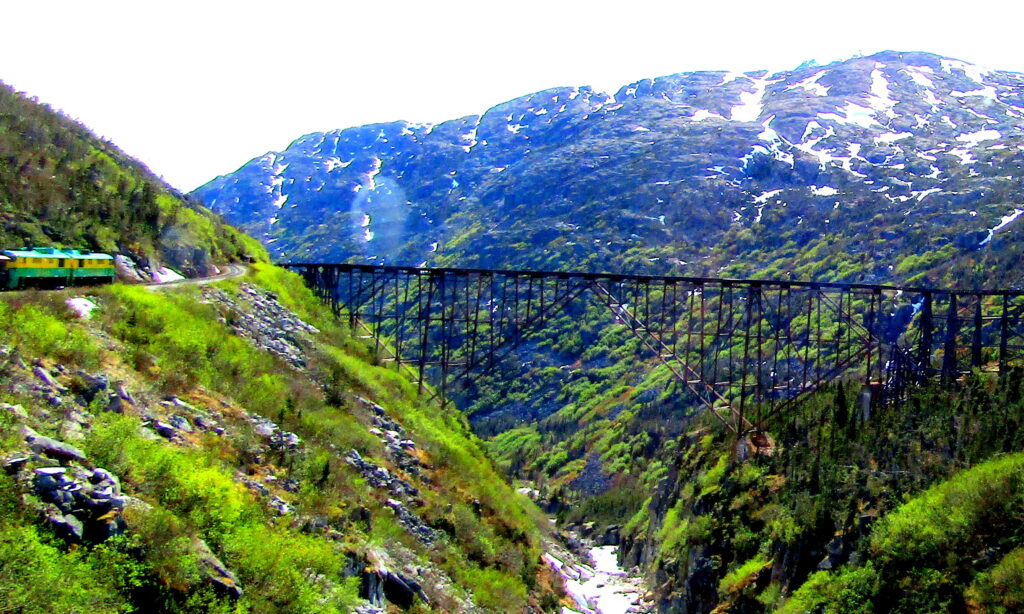
7.     Train rides from Skagway through the rugged mountains – this track goes to the Yukon territories in Canada, originally  built during the gold rush era – a big yes!

 Our ship stopped first at Ketchikan (hard rain, did nothing),

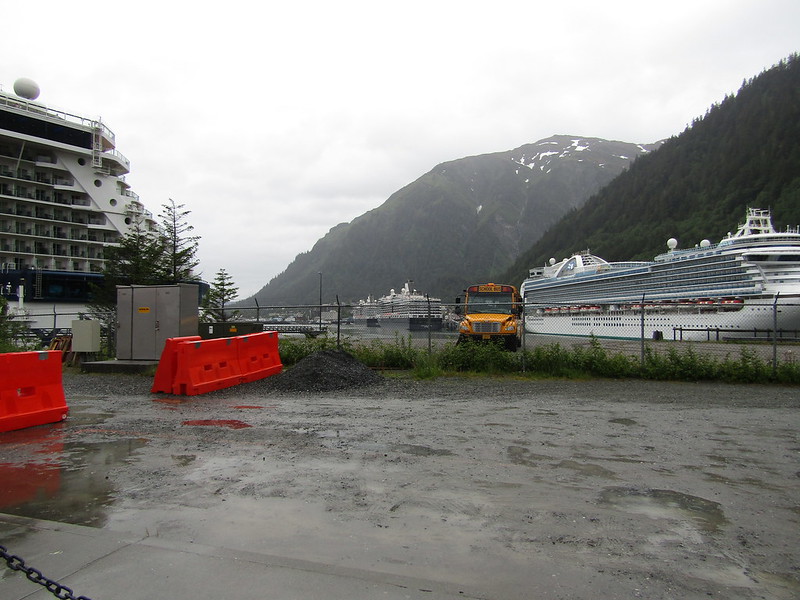
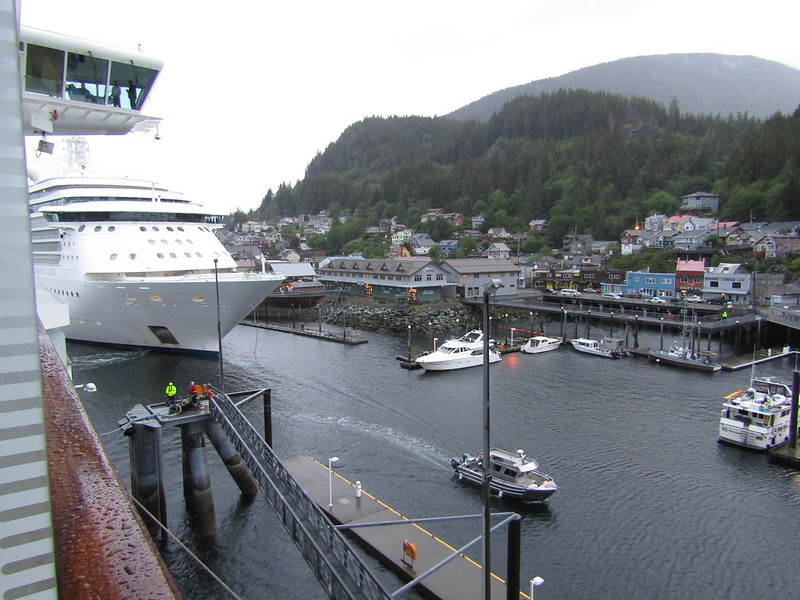
Ketchikan – Ship parking

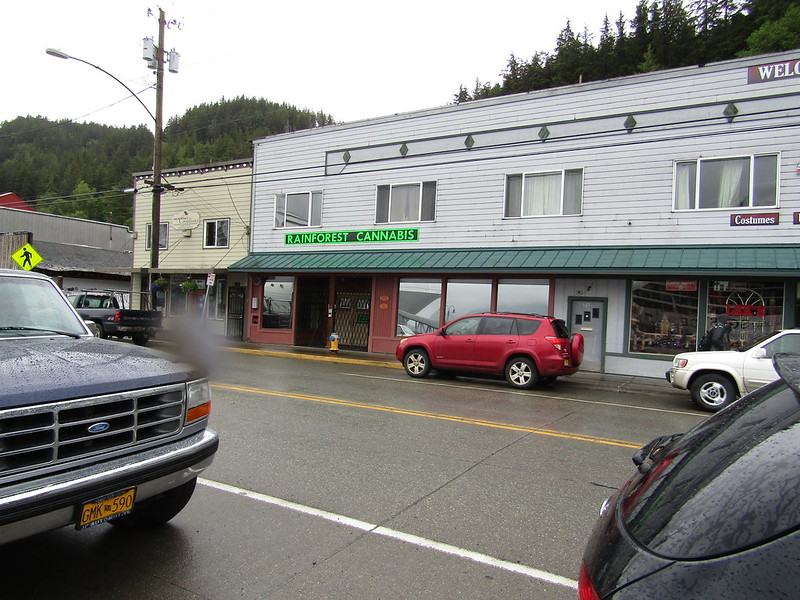
Ketchikan – I will smoke cannabis all day if I lived there!

Ketchikan, rain stopped for one minute!

Juneau (enjoyed the M glacier – but constant drizzle! )

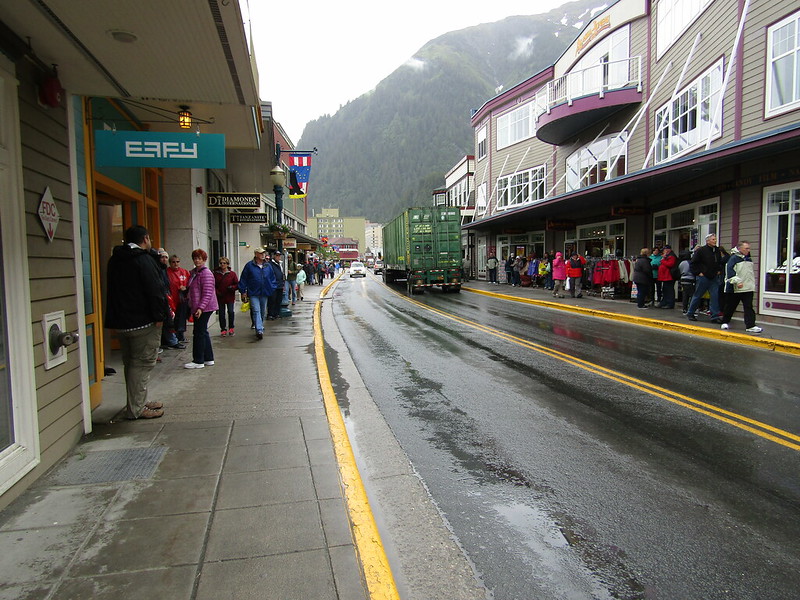
Juneau
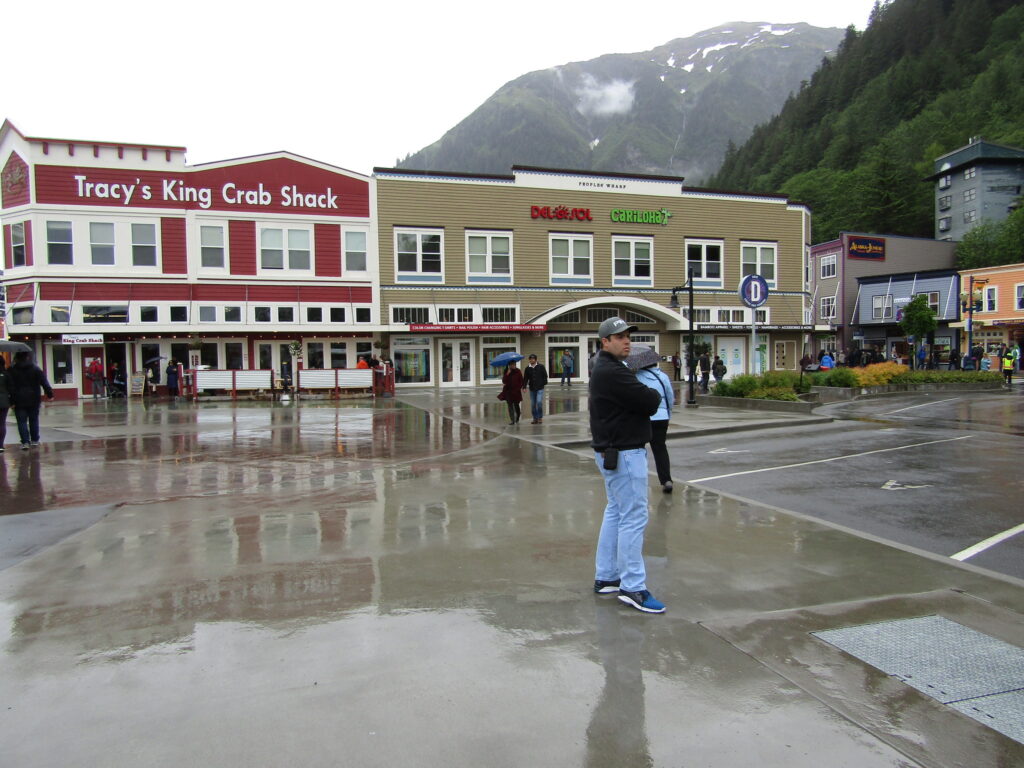
Juneau town square by the harbor

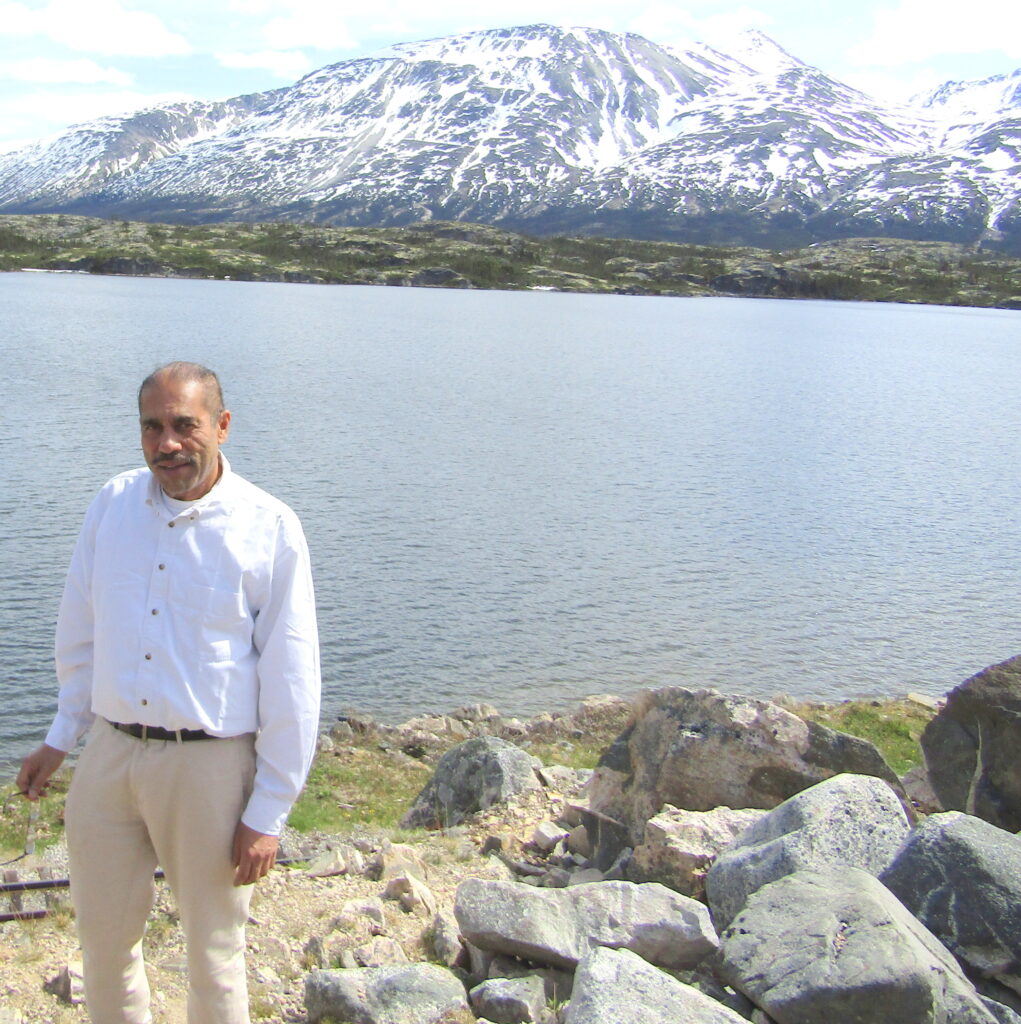
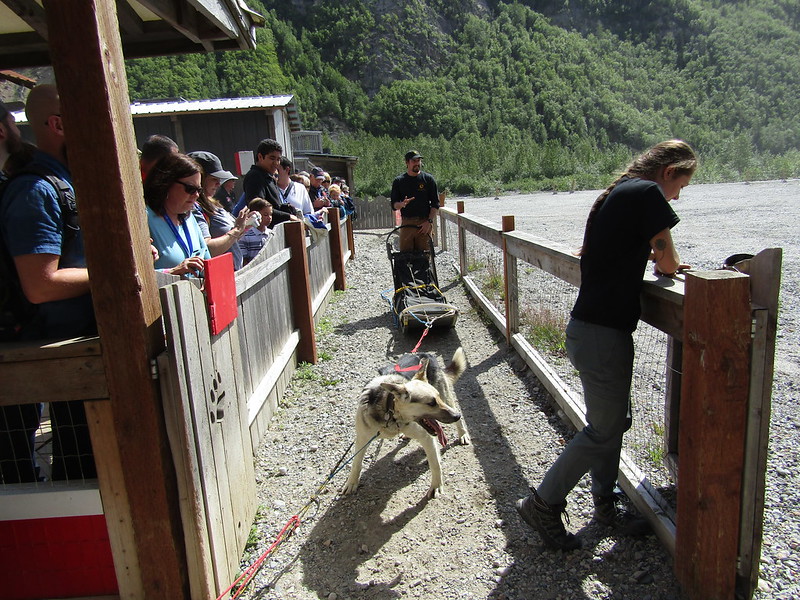
and finally Skagway ( a gorgeous sunny day, a wonderful train ride and a side trip to the Siberian Husky training Center for sled dogs). Three cities  on three different days.

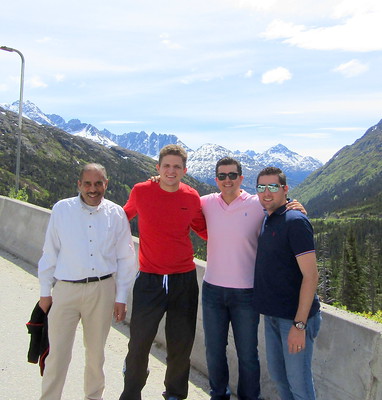
Some affluent Mexican families were vacationing with us, I had a good time hanging out with the two boys in their late twenties on the Skagway trip. Also met two pairs of Indian old couples who have retired and traveling the world now.

The train ride from Skagway to the Yukon Territories.
One bright Sunny day in Skagway, Alaska (out of eight days)!
With Mexican Hombres
View from the train

Huskies in training for sleds, poor dogs were hot even at 80 F!!

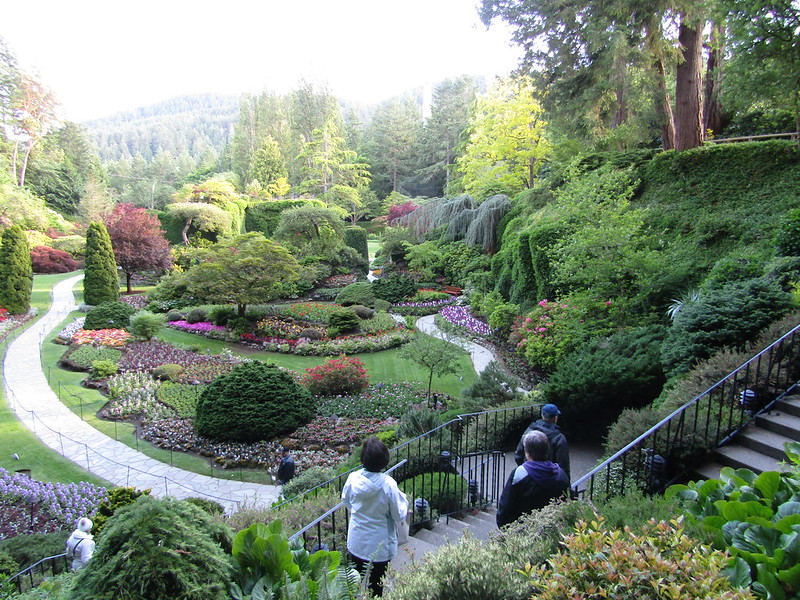
Always wanted to do Alaska, I got it off my bucket list. On the way back, the ship stopped at Victoria, British Columbia, and I got a chance to see the beautiful Buchart gardens !!

The iconic Buchart Gardens in Victoria

Outstanding Buchart Gardens
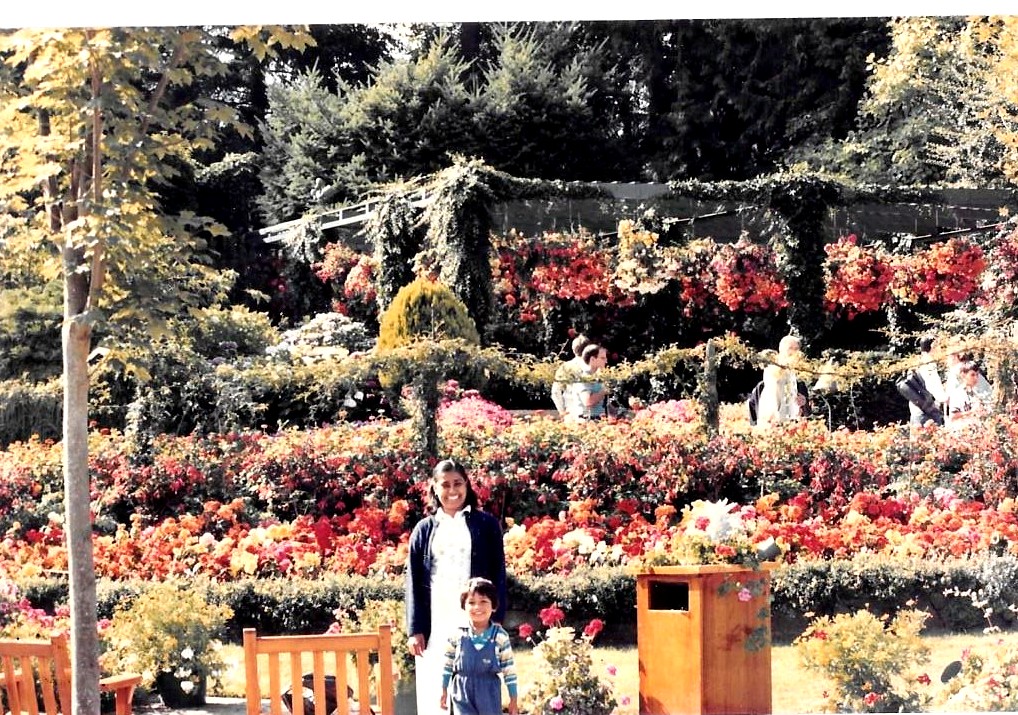
Buchart Gardens in 1987, with my son who was three years old!

Some tips for cruising:

By all means, buy an insulated beverage container. In the buffet station on the ship, high quality coffee, tea, juices and soft drinks are free, whereas anywhere else on the ship a cup of coffee is $4.50, a coke is $3.50 and so on. Heck, buy three beverage containers and a shoulder bag and carry all your daily non-alcoholic drinks with you all over the ship and in your cabin too.

There is no weight restriction on your baggage, so if you want to look really good, bring all kinds of clothes and shoes with you. BTW, the formal night when everyone is supposed to dress up is kind of defunct because of all the old fogies who insist on wearing sweatpants everyday!

If you wanna drink a lot, bring two or three liters of alcohol or several six-packs of beer with you, it will save you a lot of money. Yes you can bring alcohol on board!

Swimming and watersports no good on Alaska cruises. There is one small heated covered indoor pool and sauna which is always very crowded. Other pools are uncovered and/or unheated, and the temperature outside is about 40 – 50 degrees F

Parties happen but most passengers are over 60/65

Remember, even with the special internet package, internet does not work well on the ship

Phone calls on your mobile are chargeable and expensive, so if you want to be a chatterbox, buy a cruise ship package from your phone carrier or be prepared to spend a few hundred dollars in a week.

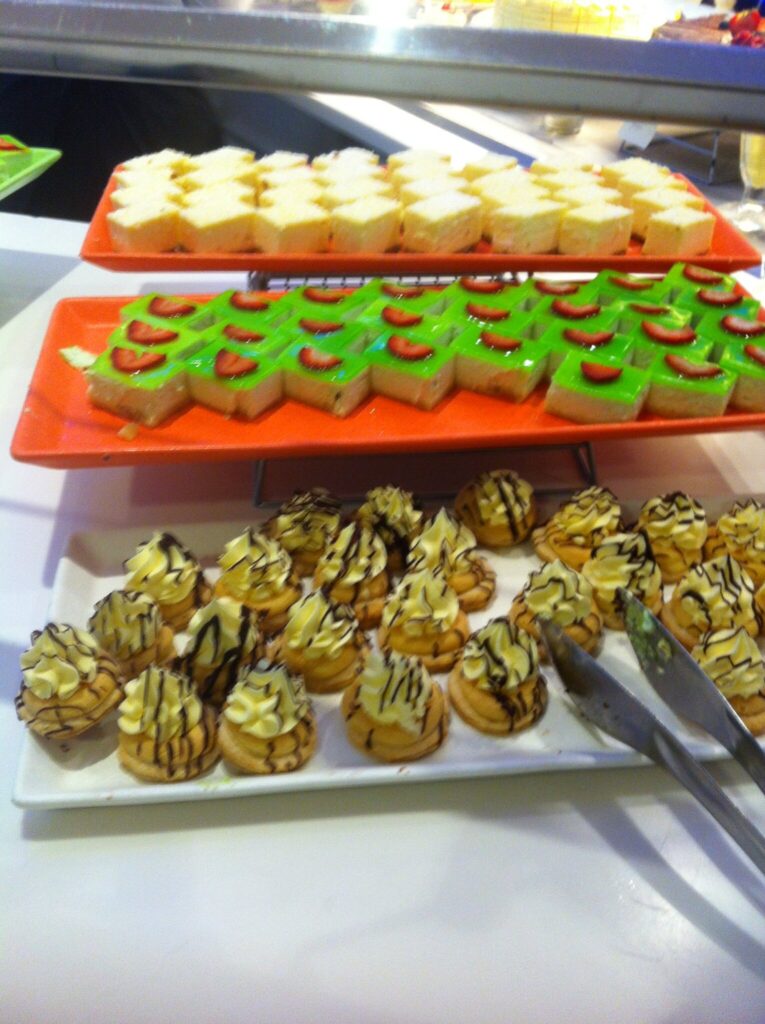
You have an option to go to one of many sit down restaurants or to the huge buffet – all are free. but the restaurants will take your order for specific items and serve you only what you ordered. In the buffet , you are free to choose basically from the best multi-cuisine, multi nation food collection I have ever seen. Unless you and your spouse want to dress up and feel like being served by a liveried waitperson, there is absolutely no reason not to go to the buffet!!

Plan to diet while on the cruise – hahahah!

The crew members are generally very attractive and multi-lingual and fun to talk to, They will hang out with you if you ask them!. If you are attractive, they will flirt with you and maybe more (although strictly against regulations!!)

Bring Winter Jackets even in June, July and August, you will need them!!

Hopefully in a couple of years we will be able cruise like we used to!!

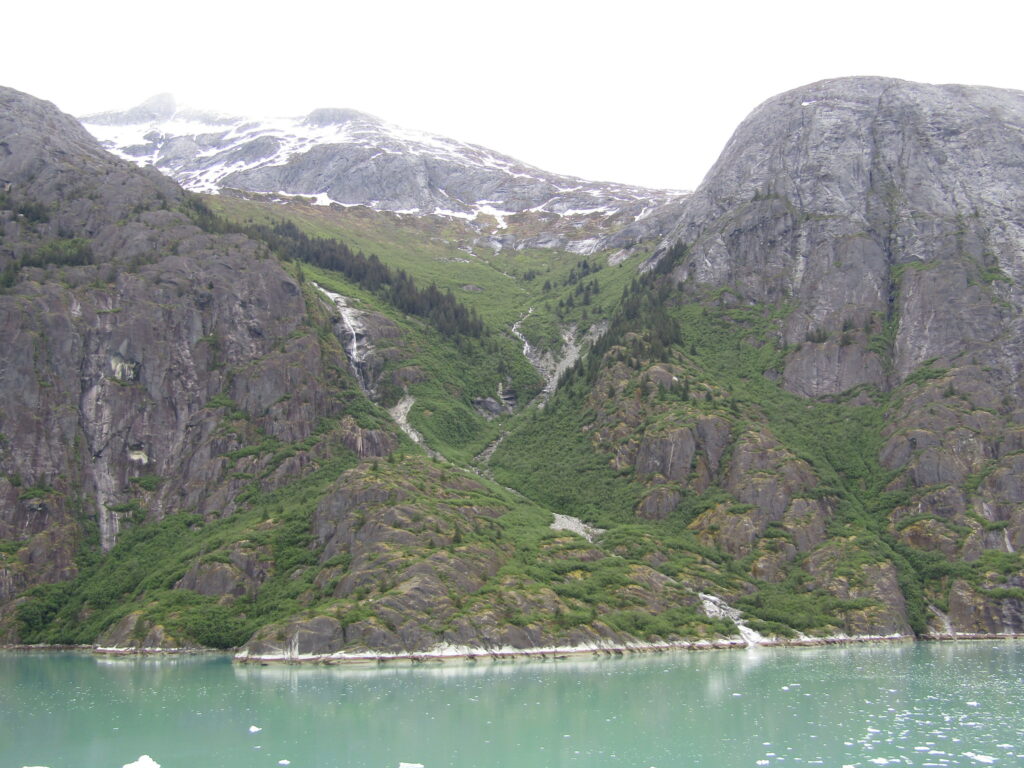
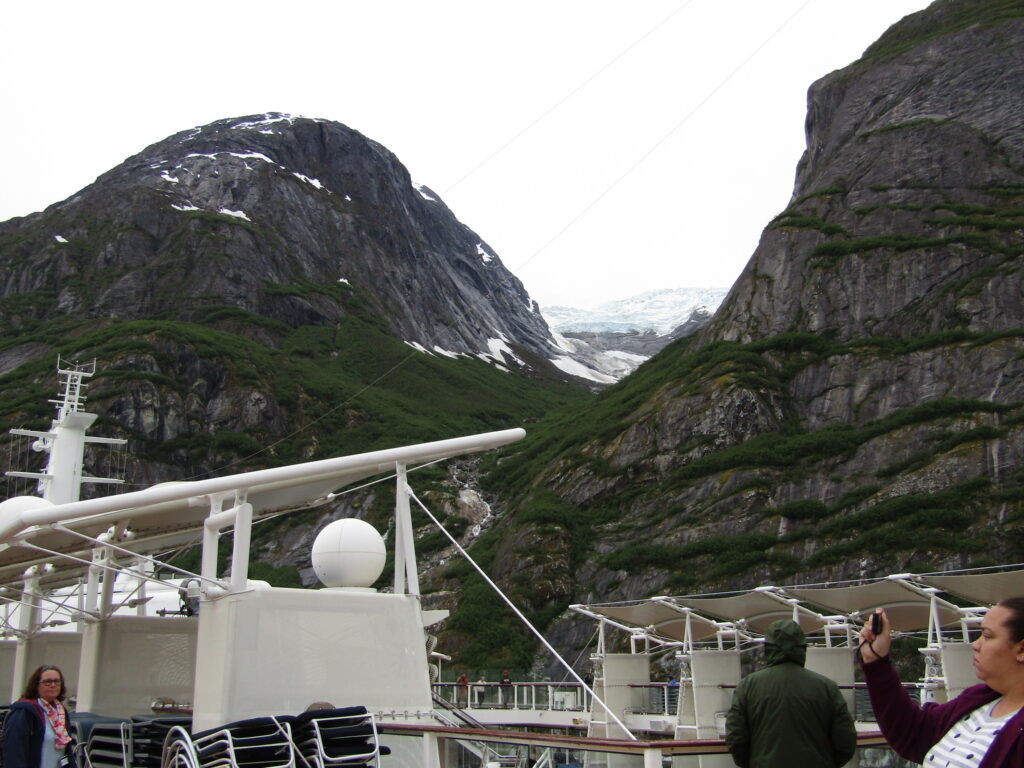
I leave you with spectacular views of the inside passage:


Memories

The Super-rich:  Arrogant  or Super- polite?

I watched “ The Crazy Rich Asians”  today, and recalled my encounter with the American-Chinese super-rich  (their status was contemporaneously unknown to me, hence the encounter caused considerable anguish) ). True Story –the names  are real –Google them for more fun!

DeMin Wu was a senior foreign –born faculty in Kansas when I joined. A  very polite  man, conscientious and unassuming – we worked together for about twenty years before he retired in early 2000’s. Not rich, not very famous , just a solid middle-class  econ professor with two nice children, Larry and Clara. I saw them coming to their father’s office in the 80’s. Mid 1980’s  Larry graduated from High School  and went to Stanford, Clara graduated high school later and went to Stanford as well.

I followed their progress over the years when internet  came around, saw that Larry was a Business School Professor  after getting a Ph.D. from Chicago and later became a head honcho in Nera consulting – the premier anti-trust  consulting group in USA.  And  Clara got an MBA from Harvard, was a finance executive who got married to a  Canadian-Chinese  finance guy  and a businessman. I was very  proud of both of them . I saw them as children of my friend (and colleague)  who have done well in life!

I never  got a chance to talk to either kid for long when they were growing up. Said hi to them  in Demin’s house at the wonderful parties where his wife cooked fantastic food,  or made small talk to them when they visited  DeMin’s office in the university.  

Fast forward to 2013, when Demin had already retired and lived in California, his children announced  the establishment of a foundation in his name at our econ department in Kansas. The modest foundation money will be used to provide a modest  fellowship to a young outstanding  faculty member every year.

On a Firday night in March, the foundation was inaugurated, and I was there (kind of half-heartedly, I always tried to avoid the institutional meetings). Several people were giving speeches about Demin’s accomplishments. I noticed Demin was absent, it was a long trip from California to Kansas – he was probably in poor health. I noticed Clara with two young kids near the podium, and Larry standing near the back of the hall, alone. I recognized both of them.  Clara’s husband,  Joseph Tsai, who I never met before, appeared to be absent.

I went up and introduced myself to Larry.

“Hi, I am Gautam Bhattacharya –I was a colleague of your dad. Are you Larry?”

He looked at me with his inscrutable eyes , smirked and said “ No, I am not Larry”.

I asked him again, perplexed now, and he told me again that he was not Larry. I slowly walked away.

I was shocked and seriously insulted – there was no way he could not have known my name – the gathering was also by invitation only!!

I actually had problems sleeping that night!

How low have  I fallen? How stupid does the world view me as? Or is there  a reason why Larry did not even want to say hi to me?

I was so disturbed that the next morning that I decided to do something very rare. There was a follow up breakfast meeting at a hotel near the university where the first of the Demin Wu Fellow’s name will be released . Ordinarily I would never go to this follow up meeting – it was a waste of time- but I went just to get to the bottom of this.

I located Clara at the breakfast meeting. I introduced myself to her. She did not deny she was Clara. I made small talk for exactly sixty seconds then went directly to the point

“You know I met your brother Larry last night – but he said he was not Larry! Do you know why?”

She paused briefly, then  looked at me with her inscrutable eyes , smirked and said “Oh, Larry is weird”!

This is about a 45 year old professional  man denying to acknowledge his name to an older professional man! – He is weird!! – WTF!!

Anyway, I left it at that. While taking a smoke break in the hotel parking lot, I saw them all leaving in a large rented SUV –Clara and Larry and Clara’s two children! They did not look different from the standard Chinese-American  professionals that you see all over USA.

A big WTF moment – I have not figured it out as of yet. But the following is my conjecture

Larry had actually become mega-successful as an anti-trust consultant during the years prior to 2013 – my info  was  about ten years out of date. He was a multi-millionaire and did not consider himself to be at par with an economics professor any longer. Instead of wasting his time talking to me, it was more efficient to deny that he was Larry! This was the Arrogant Super rich!

On the other hand, Clara’s husband Joseph had given up his huge salary in Wall Street and joined Alibaba in China in its formative years. He was the only Western-trained accountant and finance guy  and became the right hand of Jack Ma. To cut a long story short, Frank and Clara have become Multi-billionaires (one billion is one thousand million dollars) when I saw them in 2013.  Clara was not staying in a five star hotel in Lawrence because there were no real five star hotels  in Lawrence hahaha ! Clara was not going to the airport in a stretch limo because there were no  stretch limo service in Lawrence. She was not taking a helicopter to Kansas City airport from the hotel because the hotel did not have a helipad!

 But she diffused the situation with me politely and quickly when she realized that I may be upset that Larry did not want to talk to me.  This was a Super-polite, Smart,  Super-rich woman.

Clara and her husband Joseph Tsai , in their early fifties now, are independent business people. They own a professional basketball team that they purchased for 4000 million dollars !  They just donated 50 million dollars to a charity a few weeks ago. I am still very proud of both DeMin’s Children.

If you detect a tinge  of sarcasm throughout the entire narrative, this was intended!!

Why am I freaking out about corruption in India?

Corruption exists everywhere in the world, so why does it freak me out in India?

Because it is pervasive, it is in your face, and people kind of shrug off preposterous acts performed by others,

I am ready to donate about 2000 dollars to any educational institution in India on the spot, but have found no takers for the last four years!! I will write in detail about my experience with my own school later. Overall, I found that there are four types of schools

a. schools owned and run by the government. They do not accept charity

b. Government -sponsored schools – a vast majority of schools fall in this category including my old high school. They receive government funding but are also autonomous.. Technically, they can receive charity. But most of the time, the teachers are already misappropriating government funds, so the external charity will reveal the internal corruption. Let’s say the government has given funds for ten computers, and only five have been purchased. Now if I donate money for ten additional computers, the cat will be out of the bag and some people will be in big trouble!!

c. “Charitable” private non-profit Schools : sounds like an oxymoron. These accept “donations” from parents before their children are admitted . Part of the donations are used to provide scholarships to poor students,, and the major part is appropriated by the owner and his network . Serious accounting problems persist here in order to exhibit the non-profit status. Some of these schools actually provide high quality education and their owners seem so happy to be able to provide such valuable service to the society (sarcasm!)

d. Finally a small number of private schools exist primarily in remote villages, and some of those are not controlled by political parties. I am looking for one for the last few years.

I am willing to donate 1000 dollars to charity every month, but it is not possible in India. Of course, you can dump your money to temples or large foundations, but I do not want to do that. Over time I found that most NGO’s steal either some or all of your money! On the other hand, India does not have the abject poverty that was all around till the 1980’s. We do not see beggars howling on the streets, or people scrounging for food on the side of the streets or hordes of beggars at the bus stations or tram depots – a common sight when I was around in the 70’s. So, I am slowly finding out needy people and giving them money , but it takes time and patience. Like everywhere else in the world, there are scammers galore.

A cousin and his family, and another cousin’s son have built their livelihoods on corruption, so I don’t interact with them any more – that’s two out of four cousins’ families that live in Kolkata. I do not have any other surviving relatives in kolkata any longer, except maybe second cousins and their families. My mother and sister have passed away.

Several people that I met and that turned out to be friendly, cultured and well intentioned individuals revealed to have their livelihoods entirely based on corrupt practices , so I do not hang out with them any longer.

It is strange that these individuals, including my cousins’ families are baffled by my aloofness and possibly take it as a sign of my arrogance and /or early dementia!!

My good friend’s elderly father, a wonderful lonely old man, wants to hang out with me, but I am not going to, because several years ago my good friend raped a woman in his own home when I was present there. ( I have no conclusive evidence of this , so I just scream silently about this now and then)

So it is not like – “politicians in Washington are corrupt, or that Wall street managers engage in corrupt insider trading – and they are 1500 miles away from my little cocoon in Lawrence, Kansas” , it is corruption in your face in India!!

Oh, I am not miserable, I have a lot of good friends in Kolkata to hang out with. But it has become my mission to point out how corruption is pervasive and expensive for the Indian society in a way that I never anticipated.

And no, I am not going back to USA any time soon! Food is good here, and my retirement funds go a long way, and I love the people I do hang out with.

Edit: I did not want to appear presumptuous in the above post. It is just that I do not have any inheritance motive, and very limited current expenditures and needs. So I just want to give away about 33% of my monthly income to charity – that comes to about $1000 a month. I don’t need it – in USA it will be easy to find people and organizations who will make good use of it. So far, in India, I am finding it hard to give it to non-corrupt people. I have succeeded in finding some people who will use the money, but much more remains to be done. I have no motive of showing off , or being obnoxious.

My Missions

I am approaching 70 in a couple of months, do not need to or want to work at university teaching any more, have enough money so that I do not need to gamble with stocks and options. Do not need /want to do traditional academic research .

My goal is to analyze corruption in India, it is so pandemic and so pervasive. I will attack this topic with theory data, anecdotes and analysis. I will not change the world, but will provide knowledge to some people who will read my stuff.

Another lighthearted mission is to look at Driving in India – crazy and freaking insane!!

Wish me luck !!

Old Stories

These stories are at least ten years old. But I still find them interesting. Like most of my other stories, these are about NRI’s, and their families.

Family Feud  – The  Headmaster and   the  Coffeemaker

This story was written during prehistoric times- like 2010!-there were no smartphones in India, fast internet connections were available on Cable only, wireless routers were very expensive and people were worried about others stealing their bandwidth. The story is still funny, but things have certainly changed a lot!

 I don’t generally like  people  working  in computer-related fields.   I mean  – look,   a nerd who stares at endless pages of meaningless codes all day long, or tries to develop a flashier version of a stupid  handheld  gadget –  and makes  more money than the rest  of  us!

 Can you detect a little envy on my part?  Hehehe!

But I loved Ashok the geek. A very neat young man, very  hard-working I Still single, but family oriented, he  often talked about his big brother, Bhimdeb  Mukherjee, recently promoted to be the  Headmaster of a local school and his lovely  niece Pinky.

Ashok loves Coffee . He spends hours   stooped in front of his computer with  a steaming hot cup of gourmet brew from his very own pricey machine he bought at Chicago. Hey, the kid don’t have any vices and makes a lot of dough.

After a gap of five years, he went back to Kolkata for his life-changing trip in 2008, much delighted  by  the coffeemaker he ordered from an Indian website, to be delivered to his ancestral home in Behala, just before he arrived.

 Things have certainly changed in India, he noticed , especially  in his own house. Bhim, since getting his promotion, rules his school and his house both with an iron fist. The Head Sir, as students call him, has grown a formidable moustache and a  paunch.

The shiny coffeemaker has been unpacked, sitting on the kitchen counter.

“Boudi will make coffee for you tomorrow” Bhim told him as Ashok  went to bed.

Eager for caffeine, he joined the family bright and early in the living room.

“Dada likes tea in the morning”  Bhabi informed him.

Tea came, with toast and jam.

Ashok was pining for his first cup of Java. His throat felt dry, his eyelids twitched  even as he drank the muddy and sweet concoction.

The Head Sir gave him  a short lecture  on the sad state of the Marxist government in Bengal.

A second round of tea followed by  Samosas arrived. Still no coffee.

“I am making pinky’s breakfast, she will go to school soon.”Bhabi announced

Pinky ate for about forty-five minutes, with continuous coaxing from her parents.  Even at nine years old, she is a fussy eater.

Around  9 am , Ashok peeked in the kitchen.

“Can I make some coffee myself, Boudi?

Bhabi  was not amused.

“What’s the big rush? I will make it for you when I get some free time. Please sit down and enjoy yourself. Dada wants to chat with you”

Soon after, Boudi went to take a shower. Ashok peeked in the kitchen again.

OMG, the coffeemaker, the spice blender and all other kitchen equipment were securely locked in the kitchen cabinet. (Later on his mom told him that this is done  whenever bhabi  leaves the kitchen, fearing the housemaid would run away with the kitchen appliances- Head Sir’s orders, obviously!).

Around 10-30 am Ashok gave up on  coffee.

He enquired about using the internet.

“The computer is in our bedroom” The Head sir said. “ You  can   not  use it during the daytime, Bhabi needs her privacy.  Eight pm in the evening is the scheduled computer time.”

At eight pm in the evening, the whole family  marched to the bedroom. First Bhim checked his e-mail. Pinky played with the computer for fifteen minutes. Bhabi read some blogs.  Ashok got his turn around 8:45. By 9:15, Bhim came back to the bedroom.

“We will be getting ready for bed now,” he said politely.

Pretty much the same routine repeated itself the next morning. Hungry for Java and the internet, Ashok picked up his laptop and headed for the local internet  thek.

A paranoid old spinster was running the internet joint  in the late morning hours. There were mostly teens hanging around, playing video games or chatting   passionately with their internet  “boyfriends” or “girlfriends” that they have never seen in their lives. 

She  frowned as he entered and asked for his ID.

Ashok showed her his US passport, he became an American citizen five years ago.

The spinster looked at him and said “This is your American passport. I need your Indian passport or PAN card.”

“I don’t have an Indian passport, Miss, sorry!” Ashok said

She insisted that since Ashok is speaking Bangla, he must show his Indian passport.

“US passports are acceptable only from real Americans, not from you” She wryly informed Ashok.

The teenagers snickered in  the background.

Ashok stepped out, muttering some very bad words  under his breath.

A desperate  Ashok then  took a taxi to  Park Street  and found a nice coffee shop with WI-Fi and got some work done finally, with  some excellent Java to go with it.  It took three hours roundtrip to go to Park Street, even in a taxi, and the taxifare, three cups of gourmet coffee ,  snacks and internet charges ran to a hefty  2000 rupees. Even with American dollars, this is pretty steep for one day, Ashok thought. Damn it, why does he need to spend so much money?

Three days later, the gleaming coffeemaker, still a virgin, sat quietly in the kitchen cabinet.

Ashok called a family meeting in the evening. The Head Sir was annoyed.  Supposedly, he was   the only one who can call a meeting.

“Dada, why can’t I use the internet during the day/” Ashok asked.

The Head Sir was even more annoyed “I already told you, that’s in Boudi’s room. Our computer time is 8 pm.”

“Why can’t you  install a wireless router, so I can hook up my laptop anywhere? I can go get one right now.”

Ekdom noi”  The Head Sir was getting mad “ our neighbors would hack in and steal our bandwidth”

“Can  we all have some coffee now? I am getting tired of waiting for coffee” Ashok asked.

“Chee chee,  you can’t have coffee in the evening!! Matha Ghure jaabe! (You will get dizzy!)

“This is my Coffeemaker.” Ashok   exploded in rage, finally. “I bought it with my own money, I will make coffee whenever I want, wherever I want, as many times as I need.  Don’t tell me about your stupid family rules. I don’t depend on your money or your father’s money, you idiot!

Invoking one’s father in the conversation (Baap tola  in Bangla) and calling one’s dada an idiot – all in one sentence –  the Head Sir’s mouth  fell open at the enormity of this insult.

He remained quiet for a moment, his face getting beet red. Slowly,  the respectable head sir’s nostrils flared up, and a little vein on his forehead started throbbing.  His eyes popping up, the head sir finally exclaimed, with uncharacteristic profanity

““Eto boro Katha!  Get out from my house right now, you baanchot!”

(I am not translating this!)

Ashok retaliated, in English, hoping his mom would not understand,  “I have  had it with you, fatso! This is not your freaking house, it is my father’s. You just live here with your fat ass and small prick.   Next time you  ask me for money for house repair, or a  new cell phone from America, I will shove it right  through  like an express train.”

At this, mom and Bhabi gasped and  started crying quietly. Bhim sat there speechless, shaking with anger, the little vein throbbing on his forehead.  Not waiting for a response, Ashok  stormed out of his ancestral house.

This was the beginning of a deep and long-lasting rift in the illustrious  Mukherjee family. Three  years later , Ashok is still banished from the Behala House.

The siblings are on a mission . To get a little flavor of their  incendiary interaction, please browse through their recent e-mail exchanges:

To Bhim@gmail.com

Re:  My new car

Dear Big Brother:

 I was saving  a lot of money so that Pinky, your semi-retarded daughter,   can go to a decent college in America. Guess what, I changed my mind, and used the money to buy a nice car.  I am sending a pic of my brand  new BMW. Enjoy!

I  am having fun visualizing  Pinky  swinging her ponytail on her way to our  famous Behala College in a few short  years.

Best wishes

Ashok

To: AshokM@yahoo.com

Re Shaadi  enquiry

 Dear Ashok:

Remember our neighbor’s daughter Kalpana? She has recently finished law school and joined the Bar at Kolkata High Court. I must say she has turned out to be a  lovely young woman. Her parents were asking about you. It appears that Kalpana had a crush on you when she was a little girl.

I told them you  prefer to be constantly surrounded by  immoral American women (hooker  is the right word for them , I believe)   and you are not interested in getting married right now. If you change your mind, let me know.

Best wishes

Bhim

To : Bhim@gmail.com

Re: FYI

Dear Big brother:

I am planning to bring mother over here for a visit , from April to June next year.

Ashok

To: AshokM@yahoo.com

RE: FYI – problem

Dear little brother:

I am glad that you are planning to bring ma to America. There is one problem – how is she going to get from Behala  to Kolkata  airport? She has no money of her own. We give her everything she needs. But we are certainly not going to provide taxi fare for her trip to America.

Best Wishes

Bhim

To:  Bhim@gmail.com

Re: Taxi fare – no problem

Dear Dada:

 I will send you a check for  the taxi fare.

Ashok

To AshokM@yahoo.com

Re :  Yes Problem

Dear Ashok:

Sorry we do not accept your dirty American money.

Best wishes

Bhim

Are they ever going to reconcile and immerse themselves in brotherly love?

I wonder!!

As we all know, Java-addiction  is a grave  danger  to your mental  health!

  ABCD – a Vanishing Breed!

The ABCD phenomenon started in the 70’s and kind of petered out by the early  years of 2000.

ABCD: American born Confused Desi

We don’t see True ABCD’s anymore. While someone could apply for a research grant to delve into the  causes of their apparent disappearance, I will refrain from speculation in this regard.

In the 80’s and 90’s, America was teeming with ABCD’s.  Indeed, that was the golden age of ABCD’s

Some Desi’s loved them.

“See,  they are the true descendants of Mother India”, they would point to a nerdy 25-year old accountant touching the feet of some old geezer in a Hindu temple. “What cultural awareness! What spontaneous show of respect! And he was born and brought up right here  in America. Bravo betha, bravo!

Most of us that hardly go  to the temples and such   would hear about this young man and wonder about his true status.

 Skeptics like me would follow him around for days, finding him on a Saturday morning in a Bhagwat-Gita reading class, trying to hit on the priest’s toothy teenage daughter.

 The same Saturday evening, he  would furtively drive  fifty miles to a topless bar in another town,  drinking coke there,   not beer, because mom would smell alcohol on his breath and disapprove. He would ogle at the strippers but decline any lap dances because that  would cost too much money.

 Now the skeptic would smile broadly – that’s an aasli ABCD – a true specimen right there!

Alright, alright, I just made that one up.  I never actually met such an accountant,  he  was merely   the prototype. But some others that I did meet definitely qualified for a true ABCD status. 

ABCDs in love

Imran is the first one that comes to mind. He went to the college where I teach, had a serious American girlfriend, but broke up with her because his  parents would not approve of her.   

Next, he went  on a nationwide mate search through classified ads, matchmaking agencies  and such. (hey, there was no  TINDER in mid nineties!)

As luck would have it, he hooked up with Asha, a Bengali girl in Dallas. The lovebirds  cooed over long distance phone calls for a while.  His parents grudgingly agreed to a match with a hindu girl, while her parents viciously objected to a muslim boy, so Imran went to Dallas where they eloped and started living together.

Pretty normal stuff up to here, but it gets weird after this.

Imran called me  two weeks  after he eloped.

“Things are very weird,  Pronto”

“Really?”

“We found a nice apartment, and I wanted to get married right away. But Asha says we should get married only after both of us find good jobs, so that we are financially secure”

“Have you found a job yet?”

“I found a job as a bank teller, pays the bills for now, but it will take a while before I  get a real job. Asha is still looking, but not very seriously.”

“A little strange, yes.” I said

“But listen, meanwhile, our relationship is purely platonic, Asha wants to wait until we actually get married. She said she loves me more than anything else, though! Tell me, what should I do?”

“Hmmmm.. .., run away, scram!” I said “This is not gonna work”.

Obviously, Imran could not abandon the love of his life. Two weeks later, Asha’s parents found out where she lived. They came to visit, and Asha’s mom started sobbing

“Come back home, little girl!” she kept on crying.

A teary Asha went back home.

Incredibly, the fiasco continued for the next six months.

 Asha continued writing long passionate letters to Imran about how  much she loves him and how she is gonna leave her parents soon to be with him.

Imran kind of went crazy. His parents finally sent him home to  Hyderabad , their home town, for recuperation and a forced negotiated marriage. I have no idea what happened to Asha.

  ABCD N

Sita’s parents came from Medinpur, a rural district in West Bengal, way  back  late 1950’s and settled in Chicago. Sita lived   in Chicago since she was born.   An old-fashioned negotiated marriage hooked her up with my friend’s brother, Chhote, who migrated from India in late seventies.  I first went to visit them in the late eighties, five years after they were married. An hour after I arrived, I took Chhote aside

“Hey, why is Sita speaking like that? She was born here, wasn’t she?”

“You mean the thick Bengali Accent? Her parents taught her to speak with all Indians like that. It’s a sign of respect, apparently.”

“You are kidding me, right? Heck, she’s  got  this perfect. She even said deenar taybool  back there. Wow! Did you ever tell her that some people may actually be offended?

Chhote smiled, “like a hundred times.”

When we went back inside, she was talking to her colleague on the phone, a school teacher, in impeccable American English.

It was early evening. Soon, she showered, put on a clean sari and sequestered herself in the puja room for the next three hours

Chhote shrugged. “She does puja every evening for three hours, very religious you know”.

We had a late dinner, and she excused herself immediately. She was a very conscientious teacher in the Chicago public schools, worked till late at night preparing lesson plans and such.

“What about weekends? Do you get to spend any  time with her?

Chhote shrugged again. He was shrugging a lot.

“Yes,  every Saturday,  we drive out of town, to find a new temple, or a new Hare Krishna group, or some other religious gathering.  The whole day is spent on prayers, bhajans and such. The praasad  that I eat is usually pretty good though. And Sundays, she has special puja followed by lesson plans, homework-grading and all that.

“And she is only thirty years old!  Well, at least you are eating well every Saturday. ” I said

Chhote laughed. He had a lot of patience.

For two days I listened to Sita speaking  to me in the most comical Bengali accent . I left very baffled, to say the least.

Now, apart from professional and religious pursuits, young married  couples  also engage in some other pleasant  activities! I never dared  ask  Chhote and Sita about this part of  their married life.

Their childless marriage ended in a divorce after ten years. Like I said, Chhote had a lot of patience.

Well, these are the true ABCD’s. I met many others over the years as well.

Nowadays, grown up children of immigrants rib each other about being ABCD’s , but they all appear to be surprisingly well-adjusted. The real ABCd’s are in their late forties to mid fifties. However, should your profile fit the prototype of the  accountant above, shoot me an e-mail.

I will first post a retraction of this blog, and then meet you in a  bar where you prefer to drink coke.

I will buy you a coke and will gladly pay for a dance or two as well!

My Stupid Dreams !!!

None of this is going to happen in my lifetime, but I hope there are enough humans with similar interests

No WARS, no Military Forces , no army, no navy, no airforce in the whole damn world!

The world will have one international anti-terrorist force. Every country will have its own border protection law enforcement. And of course, Police and local law enforcement.

But no more wars!

No more rapes!

Legalize and Control Prostitution in all countries

Construct meeting places for young people everywhere.

Provide safety in public places – maybe some of the ex-military personnel – see above!

No Stealing of Public money

Easier said than done.

Corporate Reform

So that executives in large corporations bear more risk for their business failures

Easier said than done

Serious investment in infrastructure all over the world

Change in laws so that corporate capital is invested in long term social investment projects.

Easier said than done

I will die with my dreams!!

Senator Perdue -Stop It Already!

In our generation, a very large number of bright students left the Indian subcontinent and went to America. You see, the opportunities in India were very limited. We went with scholarships or job offers and with very little money. I went with $33 dollars and a scholarship from a top school in USA. Yes I am very grateful for this opportunity! Last year I retired with a nice nest egg of , well, more than $33.

During this wonderful journey my name was one of the problems. I know, in a noisy bar, I never tried to pick up women announcing my weird first name and long last name – I knew it will not work! But I have many sad stories about people outside noisy bars freaking out over my name, including generations of my students brutally butchering my name. After ten years of service to the University where I taught, they sent me a plaque of recognition as a token, routinely sent to all employees. My name was spelled as “Gautamman Bhaptazhachattzzaj” or something like that. Worse yet, when I called HR to complain, the lady asked me “how do you spell your name?” At that point I got a little insulted and told her to read the staff directory on her table , which had my name during the last ten years!!

One of my colleagues whose last name was “Wu” (two letters) had professional correspondence published in his name in a top Scholarly Journal from a National Institution as “Wun” – now where the hell did the letter “n” come from?

But Senator, this comment is about our children, who are in their thirties and forties now.

I remember a potential Supreme Court Judge, the head of a major government regulatory agency, and a number of top executives in Wall street and Fortune Five hundred companies that I played with when they were little boys and girls or heard about them from their proud parents when they were little.

Many of them have weird first names and last names. But they are not going anywhere, Senator!

We raised them , America raised them, now let these boys and girls contribute to your great country. They were bullied in grade school, but they are powerful and rich people in your country already!

This is from all the Raghuratanams, Bhattacharyas, Kumaramangalswamys and Shammnugans among you. Please get used to our children.

It is about time!

#myname

Paul Milgrom, Economics Nobel Prize and Research in Game Theory

This year’s Economics Nobel was awarded to Milgrom and Wilson. Notwithstanding  their characterizations by media as contributors to auction theory, both of them primarily worked in pure and applied game theory. Auction theory is actually an application of games,  Milgrom found solutions for some very peculiar and exotic  auctions , for example, auction of Radio frequencies to private companies.  This was  a very original application because of the unusual  object being auctioned (air) and the difficulty of designing  an efficient auction mechanism to maximize the gain to the auctioneer(the government).

Regardless of their contributions to auction theory, I want to point out how game theory evolved over time and what started as a very promising approach to analyzing human behavior turned out to have severe  limitations – not because not enough research was done, but on the contrary a lot of research was done by some very brilliant people (including Milgrom!)

This could be illustrated perhaps by discussing Milgrom and Roberts (not Wilson) 1982 paper in Econometrica.  Milgrom is not a lucid writer of articles, nor are most of the theoretical economists in our time. So I really started teaching  from the article from early 1990’s possibly because I did not quite understand it before that time.

Let’s take one small part of the US antitrust Law  and show how game  theory evolved and policy changed   over time

The Law simply says prevention of entry of new firms by charging a lower price (the technical term is limit-pricing) is illegal ( this is different from predatory –pricing where an incumbent firm charges price below cost to prevent entry – that is a more serious accusation)

Pre-game theory: Anytime a large corporation lowered price substantially, someone would accuse it of limit-pricing. Indeed, companies like Amazon could not  have possibly survived during those times. (1950’s/60’s) The Justice department would have busted them open!

Post  Game theory – initial stage – Research on entry games revealed that limit-pricing can not possibly be part of a subgame –perfect equilibrium.  In fact, the threat of limit-pricing is not credible , because should entry occur, the incumbent firms will then concede entry because it is always more profitable to do so.  In  a marriage when one spouse is  weak, the other one knowingly cheats because divorce is not a credible threat on the part of the weak spouse. So, even for  large corporations (who play the role of weak spouses here),  preventing entry by lowering price for the entire market  loses more money rather than allowing entry of new firms and co-existing with them.

In the light of what I said above, if we observe a large incumbent company lowering price, it is because it has a better technology and it wants to capture the market by exploiting its superior technology.  So, Amazon.com or Alibaba.com  does not try to kick out other retailers, it succeeds to capture the market by being the most efficient selling portal on the internet . Whether its actions are socially justifiable, ethical, etc, is another story.

So, the policy of the government regarding enforcement of Anti-trust Law was changed sometime in late 1970’s. Technically, limit –pricing was still illegal, but practically it was much harder to prove, because an incumbent firm will always claim to have better technology.  Anti-trust law was applied more to other non-price actions like creating effective entry barriers . IBM and AT&T were broken up during these times in massive anti-trust cases, but none were accused of limit-pricing.

Post-Game Theory –Later stage

Milgrom and Roberts took the entry game analysis one step further. They introduced two possible avatars of incumbent firms – one  high cost and one low-cost (with a better technology) . They argued that if the entering   firm does not know which avatar it is  playing against, then the high-cost firm can mimic the low cost firm and charge the low cost firm’s price. Depending on the possible scenarios of losses and profits (which is quite complex), there could be an  equilibrium where high cost avatar successfully mimics the low cost avatar, the low-cost avatar concedes the mimicry (because it costs him more not to) and the entrant does not enter because if it does, then, the probability of the avatar being low cost and the consequent  loss is greater than just not entering at all!

So we can have successful limit-pricing under incomplete information!  But then the Anti-trust policy now becomes much more complex, every single situation has to be investigated carefully to see if limit-pricing has occurred, or it is the low-cost firm selling at its normal price. A bonanza for anti-trust economists who got rich from 1990-2010 because every case became more and more complex.  Economists’ testimony on both sides of a case often involved complex game theory models and supporting data and/or refutation of the other side’s models and data. Millions of dollars were earned during this time in consultant fees. Some of my friends/colleagues got rich, and I am sure Milgrom himself availed of these  opportunities sometime during his distinguished career.

A lot of extensions were done  on Milgrom and Roberts’ paper , of course, opening up even more complex scenarios about when limit-pricing can happen.

So as more complex games were solved successfully by people like Milgrom (and not so successfully by people like me), it ultimately became clear that in a complex game with super-sophisticated players,  the set of equilibria is too  rich – which means we can not build a policy framework based on game theory .

Milgrom and others wrtote a lot of papers on firm behavior that was applied to all aspects of antitrust and government regulatory agency problems.  In fact, the limit-pricing result is only one  of many significant contributions of Milgrom, used by me for illustration here.

Pretty much this is where it stands   in the entire field of anti-trust nowadays. The economics consultants in each antitrust case or mergers and acquisitions case make a boatload of money on each side

As  game theory has been too successful ,  it still helps us to understand the basic issues, but does not provide enough guidance for complex situations – besides indicating that many things can happen with sophisticated players under an environment of incomplete information! – which is something we knew already before all this began sixty years ago hahaha!!

Well, at least we micro people do not make consistently wrong predictions like some, (not all) monetary policy guys. But, I was hoping we could do maybe a little better!!

By the way, this comment does not even come close to an evaluation of Milgrom’s scholastic works which are far broader in scope than antitrust policies. Please see the link below:

https://en.wikipedia.org/wiki/Paul_Milgrom

Lecture Notes – Market for Network Services

Market for network  services

Although the first paper on network issues was written by Rohlfs in 1974, network goods (or services) have become a very important part of  most advanced economies .

What follows is my first lecture on “Network Services”, used frequently in Industrial Organization Courses

What is the difference between an ordinary service, say a haircut and a network service, for instance telephone service?

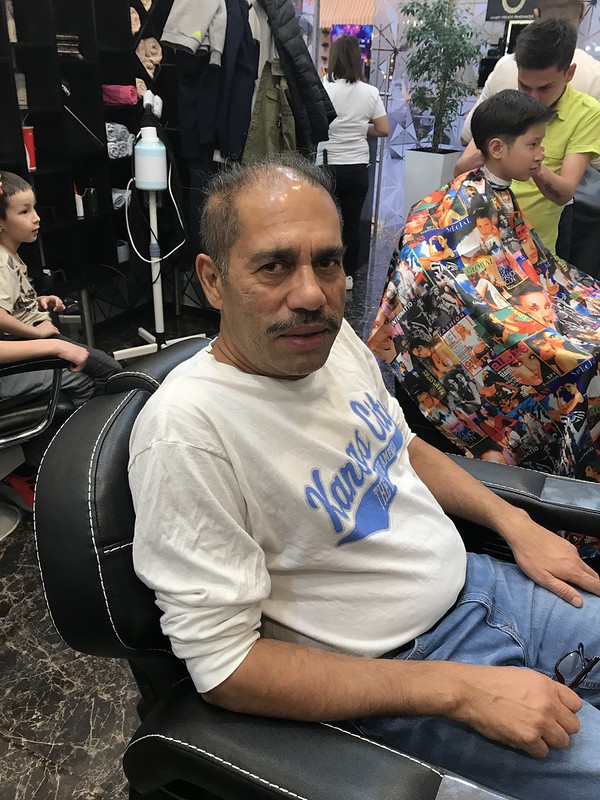
Haircut (only I look ugly as before!!)

The consumer who is getting a haircut gains utility from it, hopefully, and no one else is affected. But the utility one gets from having a phone depends on how many other people have telephones. So one consumer’s utility depends on the total number of buyers of the service. 

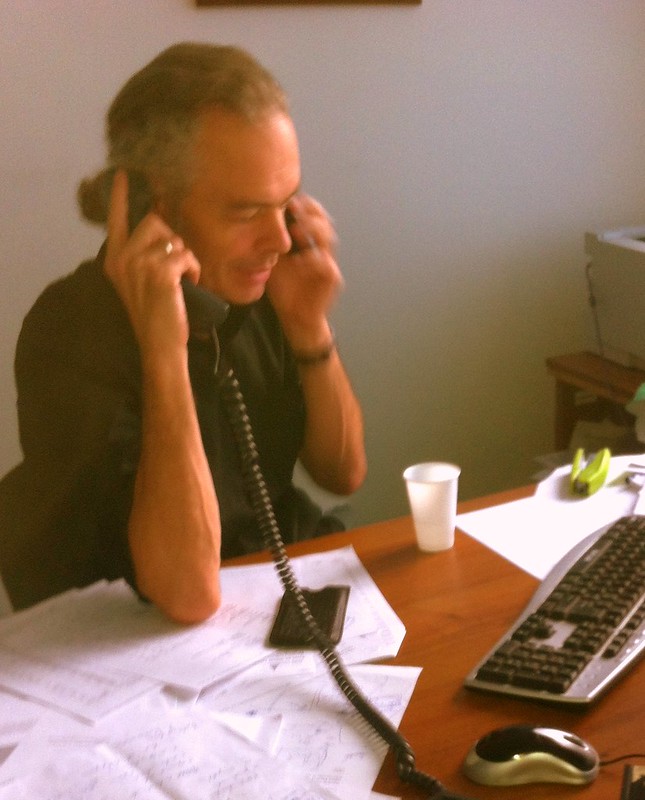
Networking!!

We will discuss two market structures, monopoly and duopoly in the network market, also compare this with the social optimum solution.  As we will see, the nature of equilibrium is substantially different from non-network goods.

First we derive the demand curve of a network service. Unlike non-network goods and services, the demand curve is not negatively sloped!  This changes the nature of equilibrium.

Assume that consumers pay a single price p for accessing the network , but there is no charge for subsequent pay per use.

 N is potentially the maximum  number of consumers that may want to subscribe to the network.  

Let vi be the value that consumer “i”  places on the network when everyone subscribes to the network. In other words, vi is the maximum amount that “i” will pay  for the network.

If all consumers are identical, then this is an easy model to analyze, but that is not a realistic assumption. So we assume that customers are different. They are distributed uniformly over the interval [0,100].

So, if the consumer knows that f is the fraction of total consumers subscribing to the network, the maximum that consumer “i” would pay is a function of f and vi. For simplicity, we assume that the consumer “i” will pay f.vi.

Therefore given a price p, there will be a consumer whose willingness to pay is vi^ such that

 The price p = f vi^.

By our assumption of uniform distribution, the fraction of consumers who want to subscribe to this service is 1 – f = vi^/100

Therefore p = 100f(1-f) after a little algebra

This is the demand curve for network services, note that this is inverse demand showing p as a function of f, when f is the fraction of the total subscribing to the network.

“f” is fraction of people in the networkp is demand price
00
0.19
0.216
0.321
0.424
0.525
0.624
0.721
0.816

This demand curve is not negatively sloped.

It is positively sloped for f < ½ , reaching a maximum at  p = 25.

Over the positively sloped range, some consumers quit (f falls), there are two effects:

Due to the price effect, demand price goes up (the people who would want to pay higher price would remain in the market)

Due to the network effect, the value of the network falls to existing customers, so some others quit as well.

As the network effect dominates the price effect over this range, as f falls, demand price p also falls

Over the negatively sloped range, the network effect is small because f is large, and the demand curve is negatively sloped.

Assuming Q = fN, we get  the total revenue curve as

Q = pfN = 100f(1-f)fN = 100f2N – 100f3N

Network monopoly with marginal cost of 11.11 (no fixed costs)

My numbers are a little different from the ones in text , pages 642-3.

Π = pfN – (11.11)fN

   = 100f(1-f).fN -11.11fN

Differentiating with respect to f, and setting to zero

100f(2-3f)N-11.11N = 0

Or

2f – 3f2 – 11.11/100 = 0

Or 3f2 -2f + (1/9) = 0

The solution is

Optimal f* = 1/6 {2 ±( 4 – 4x2x(1/9)}1/2

Which comes to f* = 0.6, p* = 24, and profit per-unit as 13.49

Total profit is 13.49N

We try zero marginal cost next

Π = pfN

   = 100f(1-f).fN

Check the solution is f = 2/3, p = 100(2/3)(1/3) = 22.22

Profit per-unit is 22.22 (2/3) N = 14.8N

If price is zero, then everyone subscribes, total demand is N

The total social surplus is 1/6 N

The government may supply this for free and charge a tax per user of 1/6 ?

The other problem is how a network is built over time. In regular market as a price is announced, there could be  a fraction of the total number of buyers at first, but the rest would come over time.

In a network market,   a fraction of buyers may come initially, but if f  is less than the breakeven point, the network may collapse if some decide to leave.

Network duopoly with Marginal cost 11.11

There is a Bertrand solution with  price = 11.11.

But there is also another Nash equilibrium where one sells at the monopoly price and the other sells at 11.11 with zero customers. Because of the network externality, the firm with price 11.11 will not get any customers, if the monopoly is there first.

Interestingly, entry is also not possible here if there is a monopoly. One way to enter would be a dynamic strategy where the entrant offers it at a zero price, at a loss. Then  the incumbent will either  offer a zero price or exit. If the incumbent offers a zero price, they can both increase their price to 11.11 and make normal profits.

Alternately, because of network externality, any initial provider should provide the service at well  below cost or for free and charge a one-time sign up fee. This would establish a large network, and new entry would be blocked since cost per period for the consumers is zero.

Lastly we generalize the monopoly model with and without fixed cost with the assumption that the consumers’ willingness to pay is uniformly distributed on an interval [0,K]. Here

P = Kf(1-f) and

Π = pfN

   = Kf(1-f).fN

Here, the monopoly price would be a function of K

Notice that the breakeven price is P = K/2